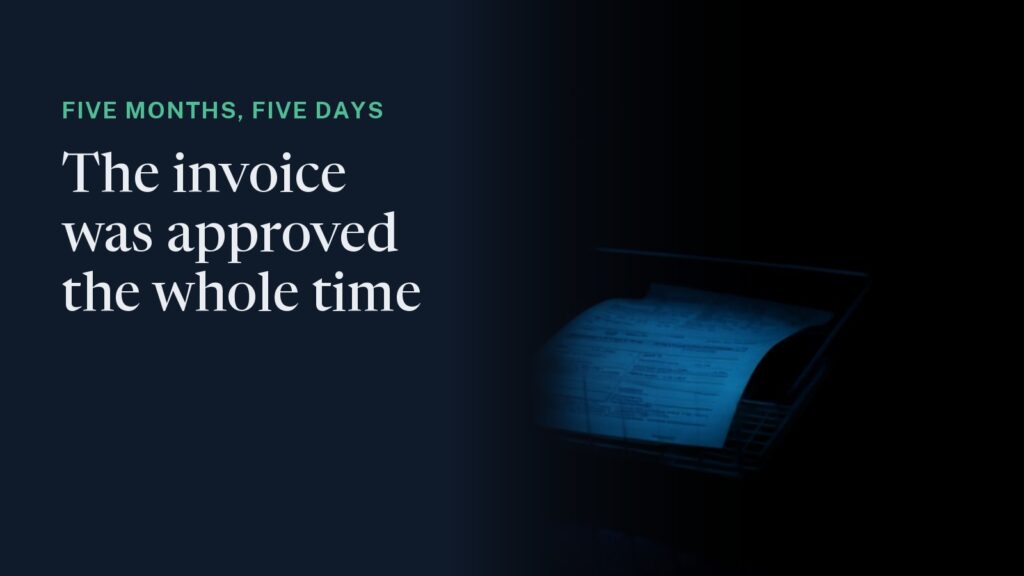
Here is a sequence I have watched play out more times than I can count. The details below are illustrative rather than any one client, but the shape of it’s exactly right, and if you invoice large organisations you will recognise it immediately.
A recruitment business places a candidate in January. The fee is invoiced on 26 January, payable within 14 days, due 9 February. A reasonable amount of money. The client is a well-known firm, no history of trouble, no reason to think about it again.
Nothing happens. Not a dispute, not a query, not a rejection. Silence.
The invoice is picked up in a receivables review on 14 July. Five months and five days after it fell due.
Why wasn’t an approved invoice paid?
Because it went to a person, not to accounts payable, and it had no PO number on it. The money had been approved the entire time. Nobody disputed that the work was done or what it cost.
The chase went to the person the business had dealt with throughout - the hiring manager who ran the process and signed off the offer. Her reply: “What is this for?”
She had never seen the invoice. She forwarded it internally, and a colleague in finance came back with the part that mattered.
A purchase order (PO) had been raised in January, before the invoice was issued. It had gone to someone at the agency and never reached the person who raises the invoices. And the invoice needed the PO number on it, sent to the accounts payable (AP) inbox, not to a named person.
The invoice was unpayable in the form it had been sent, sitting in an inbox that doesn’t process payments. Once corrected, it was paid within the fortnight.
Why does this keep happening?
The PO and the invoice travel by different routes. The PO lands with whoever won the work, and the invoice goes to a person instead of the accounts payable inbox.
The PO existed. The process broke in two places that have nothing to do with raising one. That’s why “get a PO before you invoice” is true advice that wouldn’t have prevented this.
The handover. The person who wins the work is not the person who invoices for it. The purchase order arrives in the account manager’s inbox, attached to an email about something else, and gets filed as an administrative detail rather than the payment key it actually is. Nobody involved does anything wrong. The information just doesn’t travel.
The destination. Large organisations don’t process invoices sent to individuals. They have an accounts payable inbox, an AP portal, or both. An invoice that doesn’t arrive through the correct route never enters the system at all. Your contact may be delighted with the work and entirely unable to pay you.
What does the delay actually cost?
Months of your own money, and you won’t be told it’s happening. That silence is the expensive part.
It doesn’t bounce. Nobody writes to say it’s been rejected. Your accounting system shows it as sent, your ledger shows it as overdue, and it looks like any other invoice a client is slow to pay. The failure stays silent until someone deliberately works the aged receivables.
That’s why five months isn’t unusual. It’s what happens when nobody looks.
One invoice at five months is an irritation. The problem is that this is never just one invoice.
Once the process has a gap in it, every invoice going to that client has the same gap, and every new client onboarded the same way inherits it. An agency doing this across a year is financing its clients for months at a time without having agreed to.
How do you get a PO invoice paid first time?
Five controls, and the first takes 90 seconds: when the work is agreed, ask whether a PO is needed, where invoices go and what they must show. It prevents most of the rest.
| Control | When | Why it works |
|---|---|---|
| Ask the three questions | When the work is agreed | You learn the PO number, the right inbox and what the invoice must show before the first one goes out |
| Store the PO with the job | On receipt | It belongs with the invoicing detail, not in the inbox of whoever received the email |
| Send to the AP route, copy the individual | Every invoice | Your contact is useful for chasing and rarely able to pay you |
| Review aged receivables | Every month | Nothing above works perfectly every time, so you find the failure within a month, not five months later |
| Fix the client, not the invoice | On any failure | The same fault is almost certainly sitting on every other invoice to that client |
The last one is the one businesses skip. Correcting the invoice in front of you and moving on guarantees you do this again next quarter.
Why does nobody catch it?
There’s a gap between the person who does the work and the person who bills for it, and nobody whose job is to stand in it. None of this is complicated, and none of it is anyone’s fault in particular. That’s precisely why it persists: there is no moment at which someone decides to let it happen.
Working the sales ledger is part of every Ozria clean-up, and this is the kind of thing it turns up.
If you have never checked, look at your aged receivables today and find the oldest invoice on it. Then ask why it’s there. In my experience it’s usually because nobody told you what the invoice needed to say.
Ozria Consulting runs the outsourced finance function for ambitious businesses. If your sales ledger has invoices on it that nobody can explain, book a discovery call.